By Kazi Hasnain · November 24, 2026 · 4 min read
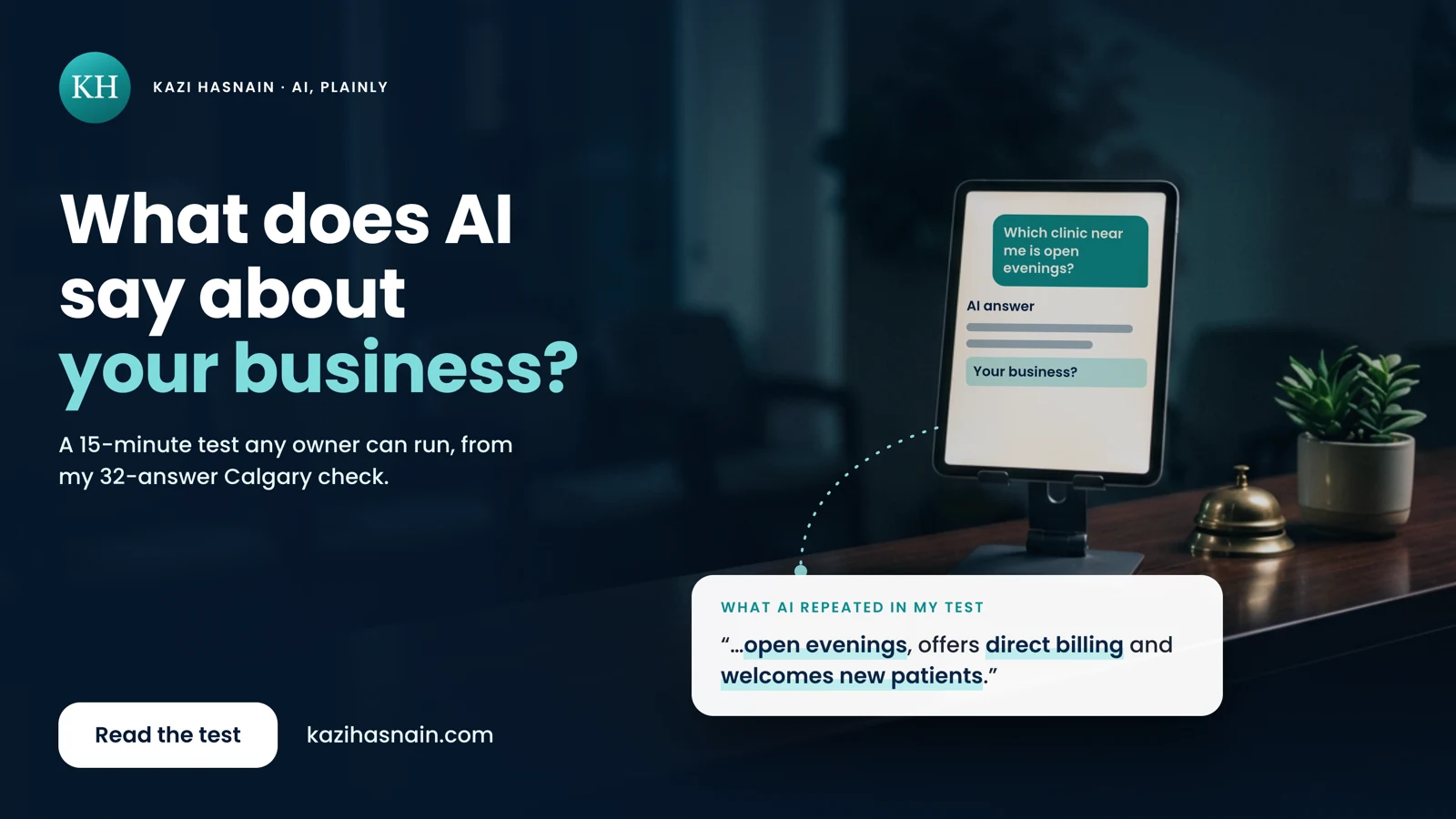
Short answer: Ask it the way a customer would. Write three questions with your service and your area, put them to three AI tools with web search on, and record whether you are named and which page is cited. It takes about 15 minutes. Repeat it monthly, because the answers change.
I ran this test on 24 November 2026 for Calgary clinics: eight patient-style questions, four AI tools, 32 answers. I'm sharing the method here because any owner can run a smaller version without paying anyone, me included.
What did my test show?
In the answers that showed their sources, 180 of 228 cited links (79%) were the clinics' own websites. Directories and "best of" lists were 15%. Of the clinic links, 62% went past the homepage to one specific page, usually a single service page.
The tools mostly repeated plain facts from those pages: the area, the hours, direct billing, whether new patients are accepted. The full results, limits and the Alberta advertising rules clinics should check are in the ReformedTech.ca write-up of the test.
The lesson for any small business is simple. An AI tool can only repeat what it can read about you.
How do I run the 15-minute test?
1. Write three questions a customer would ask (3 minutes). Use the problem, the place and one condition. For example: "Which physiotherapist in northwest Calgary is good for a running injury?" or "Who repairs furnaces in Airdrie on weekends?" Don't put your business name in the question.
2. Ask three tools (6 minutes). Use ChatGPT, Gemini and Perplexity, with web search turned on where there is a switch. Start a new chat for each question.
3. Record what you see (3 minutes). Use a table like the one below. Write down who was named when you were not.
4. Open the pages the tools cited (3 minutes). Look at what those pages state that yours doesn't. In my test it was usually one sentence: "open until 8 pm", "we direct bill", "accepting new patients".
5. Fix one page, then test again next month. Change one thing at a time so you can see what made a difference.
| Tool | Named? | Page cited | Named instead |
|---|---|---|---|
| ChatGPT | No | None | 3 others |
| Gemini | Yes | My service page | |
| Perplexity | No | A directory | 5 others |
Keep one table per question, with the date and the question written above it.
What should I look for in the answers?
Look at the reasons, not only the names. Out of my 32 answers, 26 named a quadrant or community, 17 gave opening hours, 11 mentioned direct billing or insurance, and 11 mentioned reviews or ratings. My questions asked about some of these, so treat the counts as examples, not a ranking.
Then ask one thing about each reason: is that fact written in plain words on my own site? One ChatGPT answer in my test said it had listed clinics "whose websites currently state that they welcome new patients and offer direct insurance billing".
Which mistakes make the test useless?
- Testing once. Answers vary by day and by tool. One result is a snapshot, so keep dated records.
- Asking with your own name. "Tell me about [my business]" checks whether the tool knows you. It doesn't check whether it recommends you to a stranger.
- Assuming everyone sees your result. OpenAI says ChatGPT may use an approximate location based on your IP address for local results. A customer across the city may get a different list.
- Counting only the names. The cited page tells you what to fix. The name alone doesn't.
What should my web person check?
Two quick things, about 10 minutes together.
First, open yoursite.ca/robots.txt. OpenAI says a site must allow its OAI-SearchBot crawler to be shown in ChatGPT search answers, and Perplexity recommends allowing PerplexityBot. OpenAI's GPTBot is a separate crawler used for training, so you can block that one and still appear in search answers.
Second, don't buy special "AI files". Google's guidance says a page needs to be indexed and eligible to show a snippet in Google Search, and that you don't need new machine-readable files or special markup to appear in its AI features.
What are the limits of this test?
It is a small check, not a measurement. My own run used each tool's developer connection, which can differ from the app on your phone. It covered one day, and Gemini didn't show which websites it used. No one can promise that an AI tool will name your business, and I won't.
What the test does well is show you the gap between what you offer and what you have written down. That gap is usually cheap to close.
Frequently asked questions
How often should I check AI answers for my business?
Once a month is enough for most small businesses. Use the same three questions each time so the results can be compared, and add the date to every row.
Why does ChatGPT name my competitor and not me?
Open the page it cited for them. In my test the named clinics usually had a specific page that stated the fact the question asked about, such as evening hours or direct billing. Start there before anything else.
Do I need to pay for a tool to track this?
Not to begin. A table with dates, questions and results is enough to see a pattern. Paid tracking makes sense later, when you follow many questions across several locations.
Does this work the same in Gemini and Google's AI Overviews?
Not exactly. Google says the Gemini app uses public information from Google Maps for places, including ratings and opening hours. Keep your Google Business Profile accurate as well as your website.
Next step
Run the test this week and keep the table. If the results puzzle you, book a free 30-minute call and bring them along. I'll tell you what I'd fix first. How I work on this is on the AI search visibility page, and you can send me a message if you'd rather write.
Want this set up for your business?
A free 30-minute call. You get a written quote first, no surprises.